
Verify a used boat’s title, accident history, liens, and theft status before you buy. A step-by-step guide from marine industry professionals.
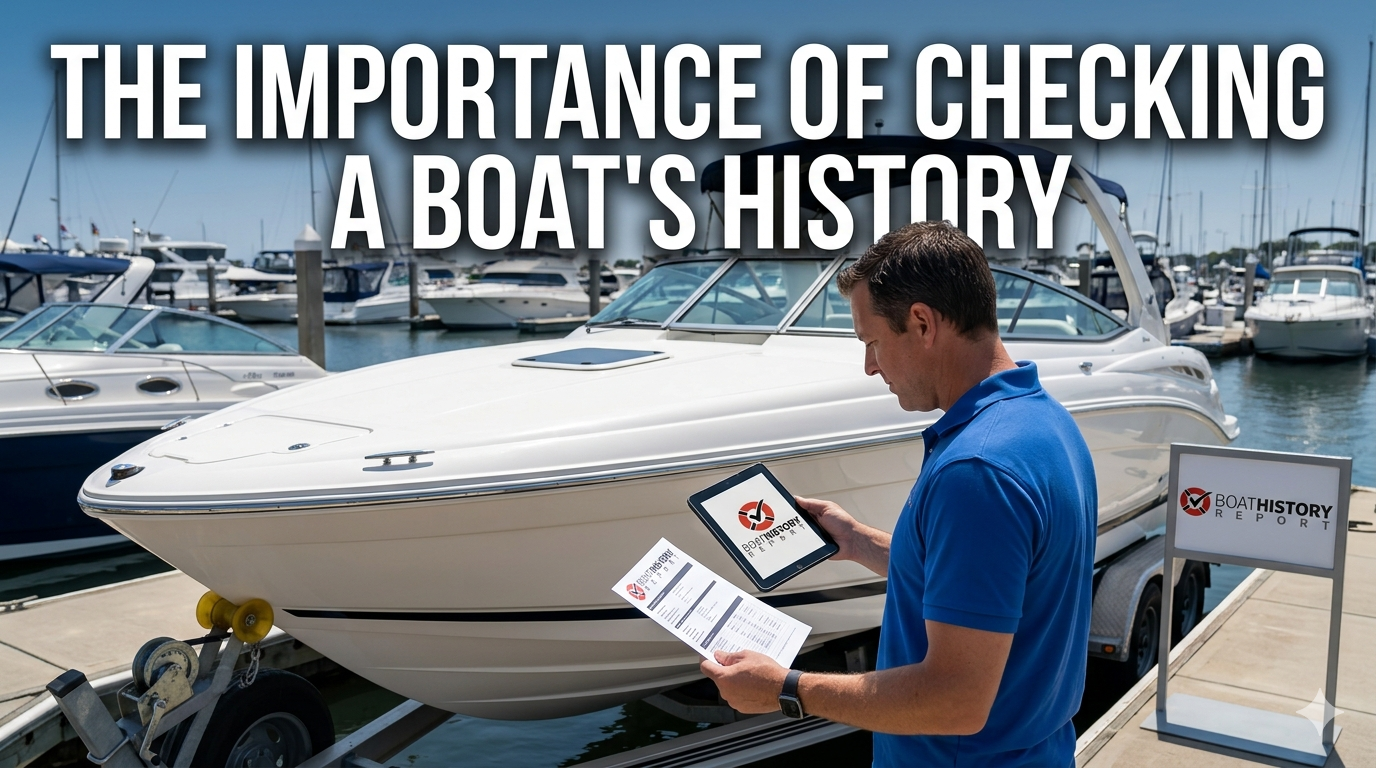
Buying a used boat without checking its history is one of the most expensive mistakes a recreational boater can make. Unlike the automotive world, where a vehicle history report is standard practice, many boat buyers still rely on a seller’s word and a visual walkaround. That gap is exactly where title washing, undisclosed salvage, hidden liens, and stolen vessel sales thrive.
This guide walks through exactly how to check a boat’s history before buying, what records actually matter, and which red flags should stop a deal before money changes hands.
Why a Boat History Report Matters More Than Most Buyers Realize
The recreational boating market involves billions of dollars in private-party transactions every year, and unlike cars, boats can cross state lines, change documentation status, and have their titles “washed” through registration in a different jurisdiction. A boat that was declared a total loss in Louisiana after a hurricane can resurface six months later with a clean title in another state, ready to be sold to an unsuspecting buyer.
A proper history check protects against four major risks:
- Financial exposure from undisclosed liens that follow the hull, not the seller
- Safety hazards from structural or engine damage from prior accidents or storm events
- Legal exposure from purchasing a stolen vessel that can be seized at any time
- Insurance refusal from carriers that decline coverage on salvage or branded titles
Step 1: Locate the Hull Identification Number (HIN)
Every recreational boat manufactured in the United States after 1972 carries a 12-character Hull Identification Number, the marine equivalent of a vehicle VIN. The HIN is your master key for unlocking the boat’s documented history.
You will typically find the HIN in two places:
- Primary location: stamped on the starboard (right) outside transom near the top
- Secondary location: hidden somewhere on the interior of the vessel (often under fittings or inside a locker), known to the manufacturer
Always verify both. If the visible HIN looks tampered with, freshly painted over, or does not match the secondary HIN, walk away. HIN alteration is a federal crime and a near-certain sign of a stolen or rebranded vessel.
Step 2: Pull a Comprehensive Boat History Report
Once you have the HIN, the most efficient way to check a boat’s history is through a dedicated marine history report service. A quality report from Boat History Report aggregates data from sources that an individual buyer simply cannot access in one place:
- State registration and title records across multiple jurisdictions
- US Coast Guard documentation data
- Reported theft and recovery records
- Salvage and total loss declarations
- Hurricane and named storm impact zones
- Manufacturer recall notices
This is the step most casual buyers skip, and it is the single highest-leverage action in the entire vetting process. A report that costs less than a tank of fuel can reveal issues that would cost tens of thousands to remediate.
Step 3: Verify the Title Status in the Selling State
Pull the boat’s current title status (or registration status if the state still does not title) directly from the state where it is presently registered. Look specifically for:
- Clean title: no brands, no liens, no salvage history
- Salvage title: the boat was declared a total loss by an insurer
- Rebuilt or reconstructed title: previously salvage, now repaired and re-titled
- Flood or hurricane brand: storm-related total loss
- Hull damage brand: structural damage to the vessel
Titles do not always travel cleanly between states. A “salvage”hull-damaged” boat in Florida may be re-registered in a state that does not recognize that brand, effectively erasing the warning. This is title washing, and it is the single most common abuse in used boat transactions. Cross-referencing prior states of registration is critical.
Step 4: Check for Outstanding Liens
A lien attaches to the vessel, not the seller. If a previous owner financed the boat through a marine lender and the loan was never satisfied, the lienholder can repossess the boat from you even though you paid the seller in full.
For state-titled boats, lien information is recorded with the state titling authority. For US Coast Guard documented vessels, liens (called Preferred Ship Mortgages) are filed at the National Vessel Documentation Center and can be searched through the Coast Guard’s online abstract of title.
Step 5: Confirm the Boat Is Not Stolen
The FBI maintains the National Crime Information Center (NCIC) stolen vessel database, but it is not directly accessible to the public. To verify a boat is not reported stolen, you can:
- Ask local law enforcement to run the HIN through NCIC (many marine units will accommodate this for a serious buyer)
- Run a report from Boat History Report which includes theft database checks
- Request that the seller meet at a marine patrol office for an inspection
Stolen boats are routinely re-titled in different states with altered HINs. Verifying both the primary and secondary HIN against the title document is essential.
Step 6: Investigate Documentation Status
US Coast Guard documented vessels (typically those over 5 net tons used in commerce or recreation) carry a documentation number rather than a state title. Documentation history reveals:
- Every recorded owner since the boat entered documentation
- All preferred ship mortgages filed against the vessel
- Builder’s certificates and changes in port of hail
- Any abstract of title irregularities
If a seller claims a documented boat has no prior owners or that the documentation lapsed without explanation, that is a red flag worth investigating before proceeding.
Step 7: Cross-Check Storm and Disaster History
Hurricane, flood, and named storm events can total a boat without ever generating an insurance claim. Owners who paid cash, carried no comprehensive coverage, or let policies lapse may simply patch the boat cosmetically and sell it as healthy.
Cross-reference the boat’s registration history against major storm events in the regions and years it was registered. Boats registered in Florida, Louisiana, Texas, the Carolinas, or the Gulf Coast during named storm years deserve extra scrutiny.
Step 8: Commission a Professional Marine Survey
A history report tells you what happened on paper. A marine surveyor tells you what is happening in the hull. For any purchase above a few thousand dollars, a SAMS or NAMS accredited surveyor is non-negotiable. Use the history report findings to direct the surveyor’s attention: if the report shows a prior hurricane registration, the surveyor knows to look harder at electrical systems, engine internals, and core moisture.
Red Flags That Should Stop the Deal
Walk away, or at minimum renegotiate aggressively, when you see:
- HIN appears altered, painted over, or does not match the title
- Title was issued in the last 90 days in a state where the seller does not live
- Seller refuses to provide the HIN before the sale
- Multiple state transfers in a short window (classic title washing pattern)
- Salvage, flood, or rebuilt brand on any prior title
- Documented vessel with an unexplained gap in ownership chain
- Outstanding lien that the seller cannot produce a satisfaction letter for
- Engine hours or condition wildly inconsistent with reported model year
Frequently Asked Questions
How much does it cost to check a boat’s history?
A comprehensive report from Boat History Report costs $59.99 for a single report or you can buy a package of 6 reports for $99.99. This is a fraction of the cost of resolving a single undisclosed lien or salvage history.
Can I check a boat’s history for free?
Some state titling authorities allow basic title status lookups online at no charge, and the US Coast Guard provides limited documentation searches. However, these sources are fragmented and only show data from that one jurisdiction. A paid report consolidates records across all states and federal sources.
What is the difference between a boat title and a boat documentation?
A boat title is issued by a state and follows state-by-state rules. US Coast Guard documentation is a federal alternative that records ownership and mortgages at the national level. A boat is either titled or documented, not both at the same time, though it can move between systems over its life.
How long does a Boat History Report take?
Your report is generated instantly after the HIN is submitted and payment is processed.
Should I run a history check on a brand new boat?
Yes. Even new boats can have manufacturer recalls, transport damage, or dealer-floor incidents that may not be disclosed at sale. The cost is low and the information is worth confirming before closing.
The Bottom Line
Checking a boat’s history before buying takes less than 30 minutes and costs less than dinner for two. Skipping it can cost you the entire purchase price. Start with the HIN, pull a comprehensive Boat History Report, verify the title in the current state, check for liens, and never close on a vessel where the paper trail does not match the seller’s story.
A clean boat with clean records is worth paying a fair price for. A boat with a hidden past is not worth any price.
Get a Boat History Report on any vessel you are considering before you close the deal. One report could save you thousands and protect you from buying a vessel with a hidden past.
About the Author: Caroline Mantel is Director of Business Development at Boat History Report and one of the marine industry’s leading voices on vessel identification, marine fraud, and boat history research. With fourteen years of marine industry experience, she serves as Vice President of the National Marine Lenders Association, 1st Vice President of the International Association of Marine Investigators (where she is the association’s expert on Hull Identification Numbers), Vice Chair of the NASBLA Vessel Identification, Registration and Titling Committee, and a member of the National Boating Safety Advisory Committee under the Department of Homeland Security. Caroline works closely with the United States Coast Guard on HIN-related policy and speaks regularly at industry events including the International Boating and Water Safety Summit, the IAMI Annual Training Seminar, NMLA conferences, and NAMS and SAMS meetings. She is a recipient of the NASBLA Award (2019), Boating Industry 40 Under 40 (2021), Women Making Waves (2022), and Bold Moves (2023).

 Boat History Report